
Aquaponics Guide
Aquaponics: A Better Way to Grow
Aquaponics combines fish, plants, water and beneficial bacteria into a living food-production system. Garden Pool has been experimenting with, designing, building and teaching aquaponic systems since 2009.
The basics
What Is Aquaponics?
Aquaponics joins two established methods of growing: aquaculture, the raising of fish and other aquatic animals, and hydroponics, the growing of plants without soil. The link between them is biological.
Fish are fed, and their waste enters the water — mostly as ammonia, both excreted directly and released as uneaten feed and solids break down. Ammonia is toxic to fish at low concentrations, so something has to process it.
That work is done by nitrifying bacteria, which colonize every wetted surface in the system: grow medium, biofilter media, pipe walls, root surfaces. One group converts ammonia into nitrite; another converts nitrite into nitrate. Nitrate is far less harmful to fish and is a form of nitrogen plants readily absorb.
Plants take up that nitrate along with other dissolved nutrients as water flows through the grow area. The water — now lower in dissolved nitrogen — is aerated and returned to the fish, and the cycle continues.
It is worth being clear about what this is not. An aquaponic system is not self-running. It needs mechanical filtration to remove solids, biological filtration with enough surface area for bacteria, dissolved oxygen for fish, roots, and bacteria alike, regular water testing, responsible feeding, and genuine care for the animals in it. The shorthand "fish feed the plants and plants clean the water" is a useful summary, but the real system is a managed biological process.
How the loop moves
- 1
Fish
Fed daily; produce waste containing ammonia.
- 2
Waste
Solids and dissolved ammonia enter the water.
- 3
Biofiltration
Nitrifying bacteria convert ammonia to nitrite, then nitrate.
- 4
Plant nutrients
Nitrate and dissolved minerals become available to roots.
- 5
Plants
Roots absorb nutrients as water passes through the grow area.
- 6
Water returns
Filtered, aerated water is recirculated to the fish.
The loop is continuous: water leaving the plants returns to the fish.
The biology
How the Aquaponic Nitrogen Cycle Works
Almost every problem a new aquaponic grower runs into traces back to this one process. It is worth understanding before you buy anything.
Stage 1
Ammonia
Fish excrete ammonia through their gills and waste; decomposing feed and solids add more. Even small concentrations stress or kill fish.
Stage 2
Nitrite
Ammonia-oxidizing bacteria convert ammonia to nitrite. Nitrite is still toxic to fish — a system stuck at this stage is not yet ready.
Stage 3
Nitrate
Nitrite-oxidizing bacteria convert nitrite to nitrate, which fish tolerate at far higher levels and plants take up as their main nitrogen source.
Those bacterial populations do not appear instantly. They grow to match the amount of ammonia entering the system, and that takes weeks, not days — longer in cold water. Establishing them before adding a full fish load is called cycling the system.
Stock a new system heavily before biofiltration is established and ammonia or nitrite will climb faster than the bacteria can process it. The usual approach is to start with a light fish load or an ammonia source without fish, test the water regularly, and increase stocking only once ammonia and nitrite readings settle near zero while nitrate is present.
University extension programs publish reliable primers on this process — the Michigan State University Extension overview of the nitrogen cycle in aquaponics is a good starting point.
Anatomy of a system
What Does an Aquaponics System Need?
Most aquaponic systems include some version of the following. How each is built — and whether it is a separate piece of equipment at all — depends on climate, scale, species, space, budget, and goals.
Fish Tank
Holds the aquatic animals and most of the system's water volume. Size, depth, and material affect temperature stability and stocking capacity.
Grow Area
Beds, rafts, channels, or towers where plants root and draw nutrients from the water.
Water Pump
Moves water between tank, filtration, and grow area. Flow rate and reliability matter more than raw power.
Aeration
Air pumps, diffusers, or falling water add dissolved oxygen for fish, plant roots, and the bacteria doing the biofiltration.
Mechanical Filtration
Removes solid waste before it decomposes in places you do not want it — settling tanks, screens, swirl filters, or media.
Biological Filtration
Surface area where nitrifying bacteria live. In media beds this is often the grow medium itself; larger systems usually use a dedicated biofilter.
Plumbing
Pipes, standpipes, siphons, and valves that set how water moves, drains, and fails safely if something clogs.
Plants
The crop, chosen for the system's nutrient level, climate, light, and root space.
Fish or Other Aquatic Organisms
The nutrient source and, in many systems, a harvest in their own right. Selection is a climate and regulatory decision.
Monitoring & Water Quality Management
Test kits, thermometers, and a routine. Aquaponics is managed, not automatic.
There is no single correct equipment list. A small media-bed system may handle mechanical and biological filtration in the grow bed itself, while a large raft system needs both as dedicated stages. Design first, then buy.
Growing methods
Common Types of Aquaponic Systems
These are the main approaches to the grow area. They can be — and often should be — combined.
01
Media Beds
Plants grow in a bed of inert medium — expanded clay, gravel, or lava rock — that is flooded and drained or continuously irrigated. The medium supports roots, traps solids, and hosts biological filtration, which is why media beds are common in backyard and first systems. The trade-off is weight and periodic cleaning as solids accumulate.
02
Deep Water Culture / Raft
Plants sit in floating rafts with roots suspended directly in aerated, filtered water. Temperature is very stable and harvesting is fast, which makes rafts a workhorse for leafy greens and larger production systems. Rafts assume solids have already been removed upstream, so filtration design matters.
03
Nutrient Film Technique (NFT)
A thin film of water flows continuously through enclosed channels, wetting the root mat while leaving most of the root exposed to air. NFT is light, space-efficient, and well suited to small, fast crops — but it has little buffer, so a pump failure becomes urgent quickly.
04
Vertical Growing
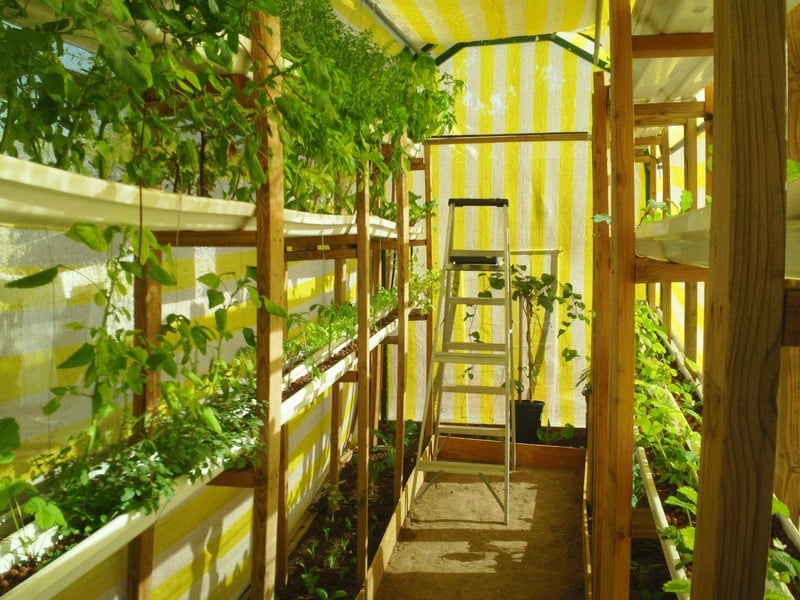
Towers and stacked systems trade floor area for height. They can raise production per square foot, but they demand careful attention to even water distribution, light reaching lower plants, root space, and safe access for maintenance and harvest.
05
Hybrid Systems
Nothing requires a system to use only one method. Garden Pool's own work has consistently combined approaches — media, raft, vertical, and other growing techniques — within a single integrated design. The right answer comes from the site and the goal, not from declaring one method universally superior.
The crop
What Plants Grow Well in Aquaponics?
Some crops are forgiving in a young system; others need a mature, well-fed one. Matching the plant to the system is more useful than chasing a list.
Leafy greens and herbs
Lettuce, kale, Swiss chard, basil, mint, parsley
Low nutrient demand and fast turnover make these the usual starting point, and the backbone of most raft and NFT production.
Fruiting crops
Tomatoes, peppers, cucumbers
Higher demand for nitrogen, potassium, calcium, and light. They generally do best in mature systems with enough root space and support.
Others worth trying
Strawberries, beans, brassicas, edible flowers
Often successful, but performance varies by system and season — treat them as experiments worth documenting.
What actually determines success
- Nutrient availability in the water
- System maturity — a new system is nutrient-poor
- Water and air temperature
- Light quantity and duration
- Root space and support structure
- Overall system design and flow
- Fish stocking and feeding rate
- Water chemistry, especially pH
No crop performs identically in every system. Expect to adjust.
The animals
Choosing Fish for Aquaponics
Fish selection is a climate decision, a legal decision, and an animal-welfare decision before it is a preference.
Water temperature is usually the deciding factor. Warm-water species such as tilapia and catfish suit hot climates and unheated systems in warm regions; cold-water species such as trout suit cool climates or chilled water. Bluegill and other locally native species can work well where they are permitted.
Not every system raises fish for food. Plenty of educational, demonstration, and home systems use ornamental fish such as koi or goldfish, which still drive the nitrogen cycle. Some integrated systems use other aquatic organisms entirely. And not every Garden Pool system includes fish at all — it depends on the design.
Check the law first. Several commonly discussed aquaponic species — tilapia among them — are regulated or prohibited in some states and countries because of invasiveness risk. Confirm the rules with your state, provincial, or national fisheries or agriculture authority before you buy fish, and never release aquaponic fish into local waterways.
Whatever you stock, stocking density, feed quality, oxygenation, and temperature stability are your responsibility for the life of the system.
Management
Water Quality Matters
In aquaponics you are managing conditions for three living groups at once — fish, plants, and bacteria — and their ideal ranges do not perfectly overlap. Good operation is about holding a workable compromise steady.
Temperature
Drives fish health, bacterial activity, plant growth, and how much oxygen water can hold. Stability matters as much as the number.
pH
The classic compromise: fish and bacteria generally prefer higher pH than plants do. Most operators hold a middle range and adjust slowly.
Dissolved oxygen
Needed by fish, roots, and nitrifying bacteria. Low oxygen is one of the fastest ways to lose a system.
Ammonia
Should read near zero in an established system. A rise signals overfeeding, overstocking, a dead fish, or failed filtration.
Nitrite
Also near zero once cycled. A spike usually means biofiltration is lagging behind the fish load.
Nitrate
The useful end product. Present and consumed by plants; very high readings suggest more plants or fewer fish.
Alkalinity
The system's buffering capacity. Low alkalinity lets pH swing sharply, which is harder on fish than a steady imperfect pH.
Your routine
A test kit and a regular schedule beat any single instrument. Write readings down — trends tell you more than snapshots.
Comparison
Aquaponics vs. Hydroponics
Both are productive, well-established methods. Garden Pool works with both — the question is which fits the situation.
| Aquaponics | Hydroponics | |
|---|---|---|
| Nutrient source | Generated biologically from fish waste processed by bacteria; some supplementation is common. | Measured mineral nutrient solution mixed and dosed by the grower. |
| Biological complexity | Three living systems to balance: fish, plants, bacteria. | Primarily plants, plus root-zone hygiene. |
| Fish | Central to the system, and often a harvest in their own right. | None. |
| Water use | Recirculating; water is topped up for evaporation, transpiration, and solids removal. | Often recirculating too; drain-to-waste designs use more. |
| Management | Daily feeding and animal care, regular water testing, filtration upkeep. | Nutrient mixing and monitoring, reservoir changes, sanitation. |
| Startup considerations | Requires cycling time to establish biofiltration before full stocking. | Can be productive sooner; requires nutrient inputs from day one. |
| Where each shines | Integrated, low-input, educational, and closed-loop food systems. | Precise, high-uniformity production and tight crop-specific nutrition. |
Neither method is a lesser version of the other. Garden Pool's position is simple: use the right tool for the situation — and quite often, a well-designed food system uses both.
Experience
Where Garden Pool Began
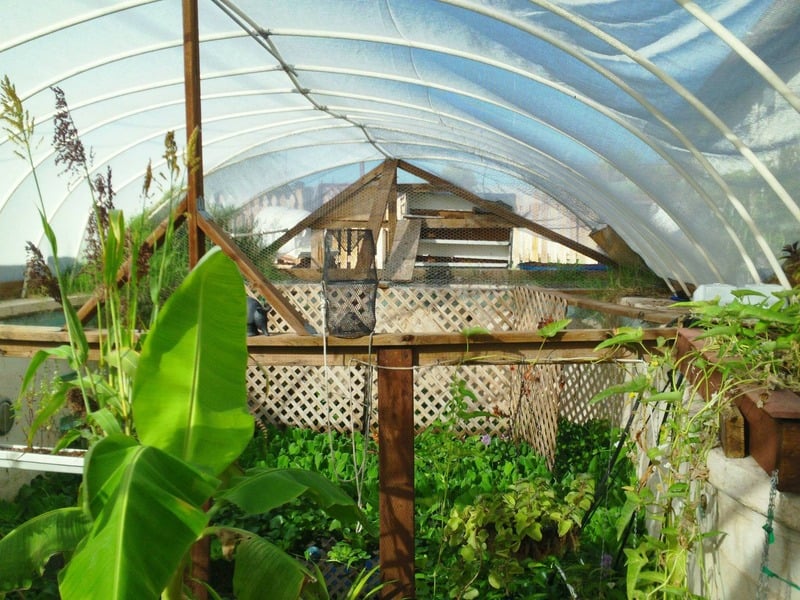
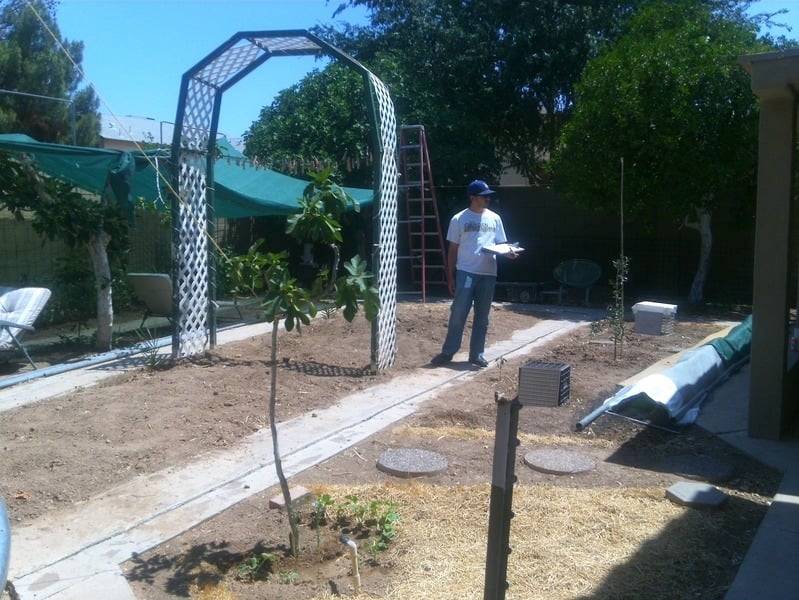
In October 2009, Dennis McClung began transforming an unused swimming pool at his family's home in Mesa, Arizona into an experimental food-production system.
The project combined aquaponics with other sustainable food-production techniques — hydroponic and vertical growing, water cycling, poultry, and shade and evaporation control suited to the Sonoran Desert. Every iteration was documented publicly, which is what turned a private backyard experiment into a method other people could learn and adapt.
What began as a backyard experiment grew into a nonprofit organization focused on sustainable food systems, education, innovation, and capacity development. Garden Pool incorporated as an Arizona nonprofit in 2012, and the work has since extended well beyond Arizona.
That history is why this page reads the way it does. The design guidance here comes from systems that were actually built, run, broken, and rebuilt — not from a survey of other people's articles.
Verified video
Original Garden Pool tour — 2015
A 2015 walk-through of the original Garden Pool system — the backyard build that started it all, showing the integrated aquaponic layout in use.
Verified video
Dennis McClung at the UN, 2019
Presenting Climate Smart Farms at the UN Solutions Summit during the United Nations General Assembly in New York.
A common question
Do You Need a Swimming Pool?
No pool? No problem.
The original Garden Pool happened to begin inside an unused swimming pool, but a Garden Pool is not defined by the swimming pool. It is a design philosophy and an integrated food-production system.
Aquaponic and integrated systems can be designed around many different environments. The design should respond to the site — its climate, water, structures, and the people who will run it — rather than forcing every location into the same template.
- Existing swimming pools
- Ponds
- Above-ground tanks
- Greenhouses
- Indoor growing spaces
- Garages and enclosed structures
- Backyards
- Educational facilities
- Community growing spaces
- Other site-specific environments
Design philosophy
Design the System Around the Goal
Before anything is purchased, the questions below tend to determine whether a system succeeds — more than the choice of pump, medium, or growing method.
- 01
What do you want to grow?
- 02
Are the fish for food, for education, or for another purpose?
- 03
How much space is available, and what is already on the site?
- 04
What is the climate — heat, cold, wind, storms, sun angle?
- 05
Will the system operate year-round?
- 06
What water and energy resources are available and reliable?
- 07
What level of production do you actually need?
- 08
Who will maintain the system, and how often?
- 09
What is the budget, including operating cost?
A successful aquaponic system begins with good design, not a shopping list.
For homeowners
Want to Build an Aquaponic System?
Garden Pool's Design & Build service follows three steps — and you can use one, two, or all three.
Step 1
Consultation & 3D Design
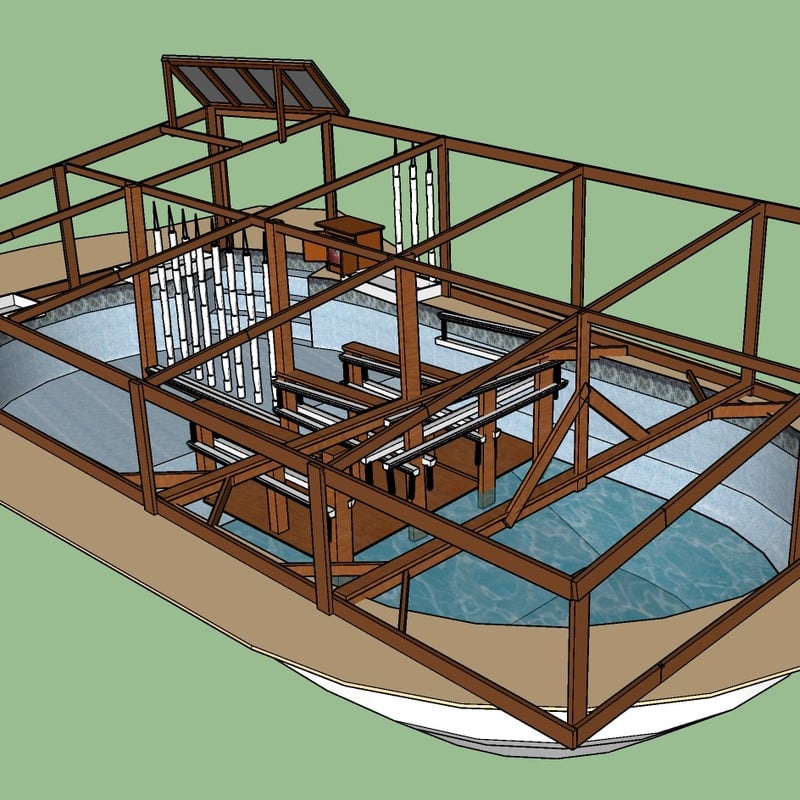
Site, structure, water source, climate, and goals are reviewed, then turned into a custom 3D model of the proposed system.
Step 2
Material List & Build Plan
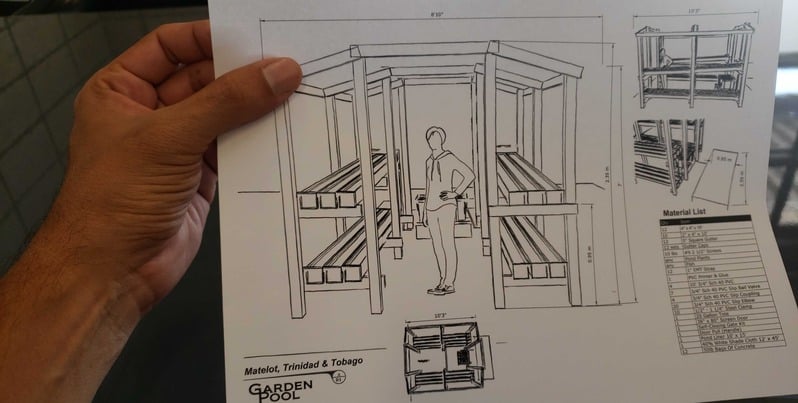
A detailed materials list, component breakdown, and construction sequence, so the real scope is clear before work begins.
Step 3
Project Management
Guidance through implementation, coordinating with you, volunteers, tradespeople, and contractors.
We can help you with one step, two steps, or the whole process.
For organizations
Aquaponics for Education, Communities and Organizations
Aquaponics is not only a way to produce food. Because the whole nutrient cycle is visible and measurable, it works unusually well as a teaching and research platform.
- An educational platform for biology, chemistry, and food systems
- A demonstration system people can evaluate with their own eyes
- A community food-production tool
- A research platform for growing methods and water use
- A workforce-development and training environment
- One component of a larger sustainable food system
Garden Pool works well beyond residential projects. Universities, schools, nonprofits, community organizations, agricultural organizations, government agencies, and international development organizations are welcome to get in touch about appropriate projects, training, or collaboration.
Verified video
IICA Goodwill Ambassador designation
Dennis McClung on Climate Smart Farms and their application across the Caribbean, Latin America, and South America.
Garden Pool Academy
Go Deeper With Garden Pool Academy
Garden Pool Academy is the developing educational home for Garden Pool's knowledge — turning decades of hands-on building and teaching into material people can actually use.
- Aquaponics
- Hydroponics
- Sustainable food-system design
- Water systems
- Appropriate technology
- 3D design
- Controlled-environment agriculture
Course enrollment is being rebuilt — the Academy page lists the subjects currently being prepared.
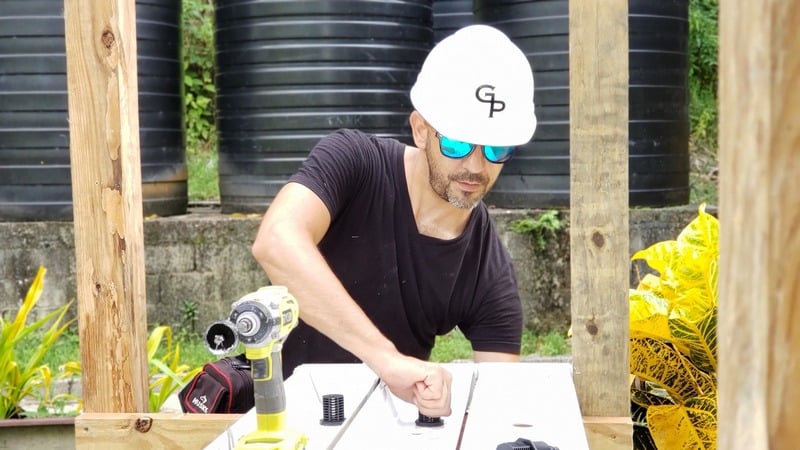
Want something to build this weekend? Try the restored Garden Pool classics: Introduction to Shelfponics, our original bookshelf aquaponics system, or How to Make a Simple 5-Gallon Bucket Aeroponics System.
Questions
Aquaponics Frequently Asked Questions
Short answers to the questions we hear most. Where results depend on design, climate, or scale, we say so rather than quoting a number.
What is aquaponics?
Aquaponics is a method of growing food that combines aquaculture — raising fish or other aquatic animals — with hydroponic plant production in one recirculating water system. Beneficial bacteria link the two by converting fish waste into forms of nitrogen that plants can absorb.
How does aquaponics work?
Fish are fed and produce waste, which contains ammonia. Nitrifying bacteria living on surfaces throughout the system convert ammonia into nitrite and then into nitrate. Plants take up nitrate and other dissolved nutrients as water passes through the grow area, and the water is returned to the fish. Pumps, aeration, and filtration keep the cycle moving and keep conditions safe for the fish.
Is aquaponics difficult for beginners?
It is learnable, but it is not hands-off. A beginner needs to understand basic water chemistry, cycle the system before adding many fish, feed responsibly, and check the system regularly. Starting small and simple is usually the fastest way to learn.
What fish can be used in aquaponics?
Tilapia, catfish, trout, and bluegill are commonly used, and some systems use ornamental fish such as koi or goldfish instead of food fish. The right choice depends on water temperature, system size, intended use, and — importantly — the laws in your area. Some species are restricted or require a permit, so check with your state or national fisheries authority before stocking.
What vegetables grow best in aquaponics?
Leafy greens and herbs — lettuce, basil, kale, chard, mint — are the most forgiving, especially in a young system. Fruiting crops such as tomatoes, peppers, cucumbers, and strawberries can do well in a mature, well-managed system with adequate nutrients, light, and root space. Results vary with system design, climate, and management.
Does aquaponics use less water than conventional gardening?
Because water recirculates instead of draining away, aquaponic systems generally consume less water than open-field irrigation of the same crop. How much less depends on the design, the climate, evaporation, and how the system is operated, so we do not publish a single percentage.
Do I need a swimming pool for aquaponics?
No. The original Garden Pool was built inside an unused swimming pool, but aquaponic systems can be designed around ponds, tanks, greenhouses, indoor spaces, garages, backyard structures, schools, and community sites. The design should respond to the site you already have.
Can aquaponics work indoors?
Yes, with supplemental lighting, adequate ventilation, and attention to humidity, drainage, and electrical safety. Indoor systems trade natural light and space for climate control and year-round stability.
Can aquaponics work in Arizona?
Yes — Garden Pool's own work began in Mesa, Arizona in October 2009. Desert conditions make shade, evaporation control, and water temperature management central design concerns rather than afterthoughts.
What is the difference between aquaponics and hydroponics?
Hydroponics delivers a measured mineral nutrient solution directly to plant roots. Aquaponics generates most plant nutrients biologically, from fish waste processed by bacteria. Hydroponics offers tighter nutrient control; aquaponics adds a living animal system to manage. Both can be highly productive — the right choice depends on the goal.
How much does an aquaponics system cost?
It ranges enormously, from a small system assembled largely from salvaged materials to an institutional installation with backup power and climate control. Cost is driven by scale, structure, climate control, plumbing, and how much labor is done in-house. A design step early on is usually what keeps a budget realistic.
Can Garden Pool help design an aquaponics system?
Yes. Garden Pool offers consultation and 3D design, material lists and build plans, and project management support for homeowners, and works with schools, universities, nonprofits, agencies, and community organizations on demonstration, training, and capacity-development projects.
Garden Pool
Build. Learn. Grow.
Whether you're imagining a backyard food system, learning aquaponics for the first time, or developing a larger educational or community project, Garden Pool can help turn the idea into something practical.