
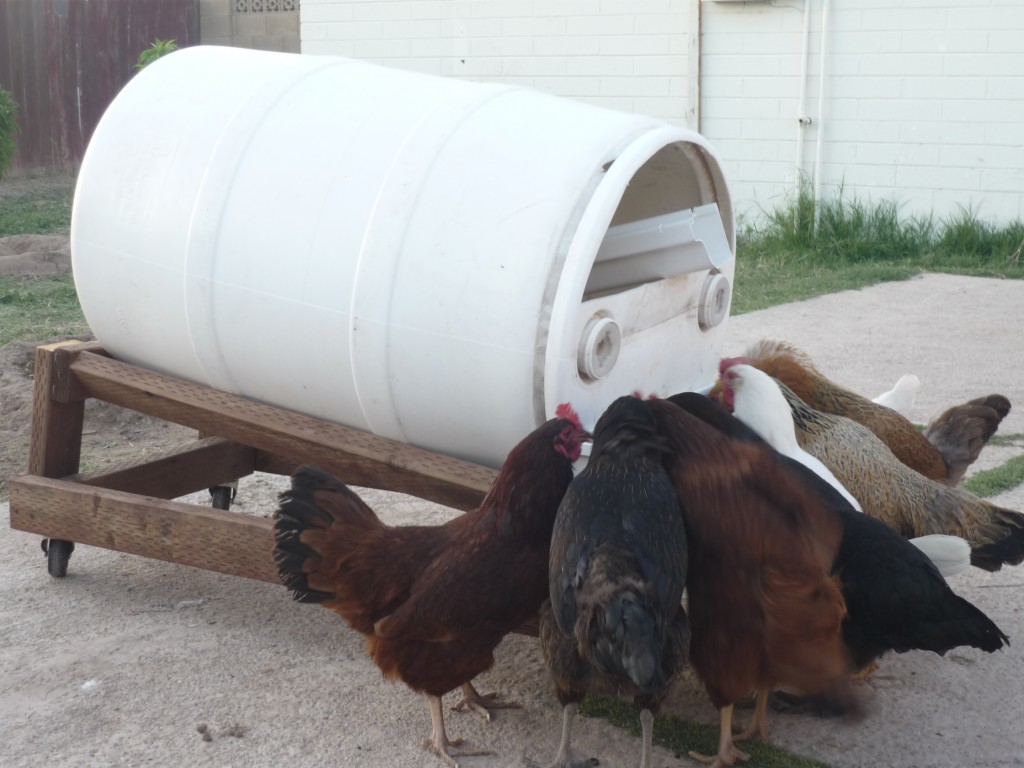
Black Soldier Fly Composter / Automatic Chicken Feeder
A 55-gallon barrel composter on a wheeled frame, designed so mature black soldier fly larvae harvest themselves straight into the chickens' feeding gutter.
Garden Pool Classic • 2011
Originally published March 28, 2011 by Dennis McClung — Garden Pool
- Original design
- Garden Pool
- Designer / instructor
- Dennis McClung
- Original publication
- March 28, 2011
- Original class
- April 23, 2011
- Location
- The Garden Pool, Mesa, Arizona
System size
55-gallon food-grade barrel
Uses
- Organic-waste processing
- Black soldier fly larvae cultivation
- Self-harvesting larvae
- Supplemental chicken feeding
- Closed-loop food-system education
Garden Pool had already been harvesting black soldier fly larvae to feed its chickens — but the setup needed a better design. After much thought, this is the one Dennis built.
Food and garden scraps go into the barrel and the larvae do the rest, converting the scraps into larvae and organic residue. Once the larvae mature, they crawl up the rain gutter and fall into the chicken feeder. When the barrel fills, it is lifted off and emptied into the compost pile.
The original 2011 article summed it up simply: the device reduces household waste and provides a free dietary supplement for your chickens.
The original design goals
- Large enough for plenty of compost
- Portable so it could be moved
- Auto-feeds the chickens
- Easy to build and replicate
- Made from common materials
The system
How the automatic black soldier fly feeder works
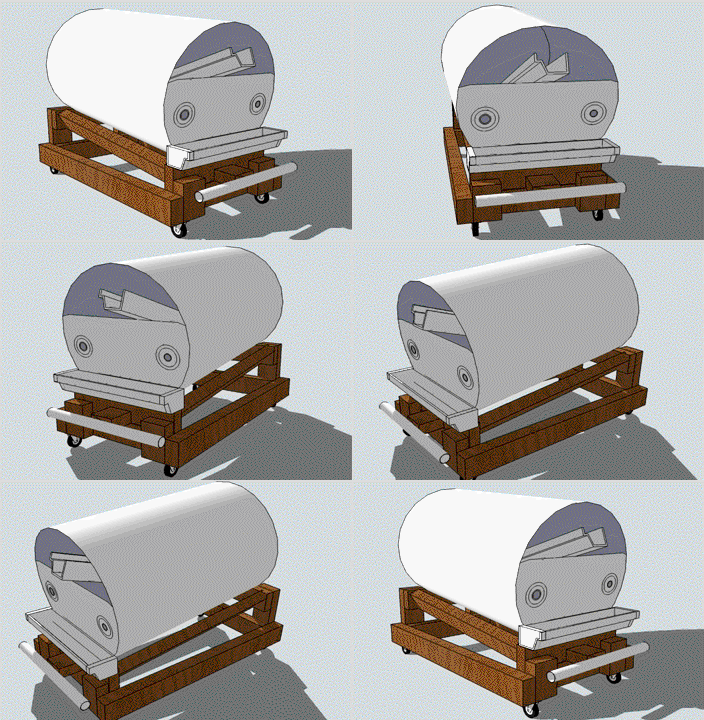
The 55-gallon barrel is the organic-material and larvae chamber. It sits on a wooden frame built from three 2x4s.
The frame's legs are deliberately unequal — 6 inches on one side, 12 inches on the other — so the barrel sits tilted.
Inside the barrel, a 39-inch length of rain gutter runs against the back wall as a migration ramp. Larvae climbing it leave the barrel and drop into a second, capped length of gutter mounted across the front of the frame, where the chickens can reach them.
Four swivel casters make the whole unit portable.
Waste in, feed and compost out
- Organic waste
- Black soldier fly larvae
- Self-harvesting ramp
- Chicken feed supplement + compost / organic residue
A modern diagram drawn to supplement — not replace — the original 2011 Garden Pool imagery on this page.
The clever part
Why the larvae harvest themselves
As black soldier fly larvae mature toward the prepupal stage, they stop feeding and migrate away from the material they have been living in, looking for somewhere dry to pupate. They climb.
Instead of sorting larvae out of the composting material by hand, the Garden Pool design simply puts a ramp where they already want to go. A natural behaviour becomes a passive harvesting mechanism — no motors, no screens, no labour.
The migration path
- Organic material
- Larvae feed
- Larvae mature
- Natural migration
- Ramp
- Collection / chicken access
Original 2011 materials list
Materials
- (3) 2" x 4" x 8' treated lumber
- (1) 55-gallon food-grade barrel
- (2 linear feet) 3/4" PVC
- (5 linear feet) rain gutter
- (1 pair) rain gutter ends
- (4) 3" swivel caster wheels
- (1 box) deck screws and appropriate bit
Original 2011 tool list
Tools
- Cordless 3/8" drill or larger
- Circular saw
- Variable-speed jig saw
- 1" drill bit
- Marking utensil (sharpie, crayon, pencil)
- Measuring tape
- (2) saw horses
- Safety glasses
The original article linked to a separate 2x4 cutting guide. That guide has been recovered from the archive and is shown with Step 01 below.
Before you build
Safety first
This safety section is a modern addition to the restored page. It was not part of the original 2011 text.
- Wear eye protection whenever you cut or drill.
- Follow the manufacturer's instructions for every power tool.
- Secure lumber on the saw horses before cutting.
- Secure the barrel so it cannot roll before drilling or cutting it.
- Take care with cut plastic — the edges can be sharp.
- Work in a ventilated area.
- Use a food-grade barrel that has never held hazardous chemicals.
- Wash and prepare any reclaimed container appropriately before use.
- Keep children and animals away from the work area.
- Check your local rules on feeding insects or food scraps to livestock.
Garden Pool does not give veterinary, food-safety or animal-feed guarantees.
Cut list
Original 2x4 cutting guide
Three 2" x 4" x 8' boards are cut down as shown. The original article noted that this layout produces only about 5% wood scrap — a characteristic of Garden Pool's own plan, not a universal result.
The recovered guide shows: two 36" pieces, two 42" pieces, two 12" legs, two 6" legs, four 19.5" pieces, one 4" front guard, and 14" of scrap.
For Dennis to confirm: the written 2011 instructions call for two 19" pieces in the barrel base, while the recovered cutting guide shows four 19.5" pieces. Both are preserved here exactly as they appear in the archive rather than reconciled.

From the archives
Watch the original Garden Pool class
This class was recorded live in a classroom setting at the Garden Pool in Mesa, Arizona. The video below is the same Vimeo recording that was embedded on the original 2011 page.
- When
- April 23, 2011
- Where
- The Garden Pool, Mesa, Arizona
- Who
- Dennis McClung, GardenPool.org
- Length
- Approximately 16 minutes
- Format
- Recorded live in a classroom setting
Step by step
How Garden Pool built the black soldier fly composter
The original illustrated instructions, laid out as numbered steps. Every photograph and diagram here is the original Garden Pool image from 2011.
01
Cut the lumber
Begin by cutting the 2x4s using the original Garden Pool cutting guide. A circular saw and two saw horses are all that is needed.
The original article noted that this cutting layout leaves only about 5% wood scrap — a characteristic of Garden Pool's own plan rather than a universal result.
The original 2011 Garden Pool 2x4 cutting guide, recovered from the archive. 02
Build the barrel base
Assemble the rectangular barrel base from two 19" pieces and two 36" pieces, as shown in the original image.
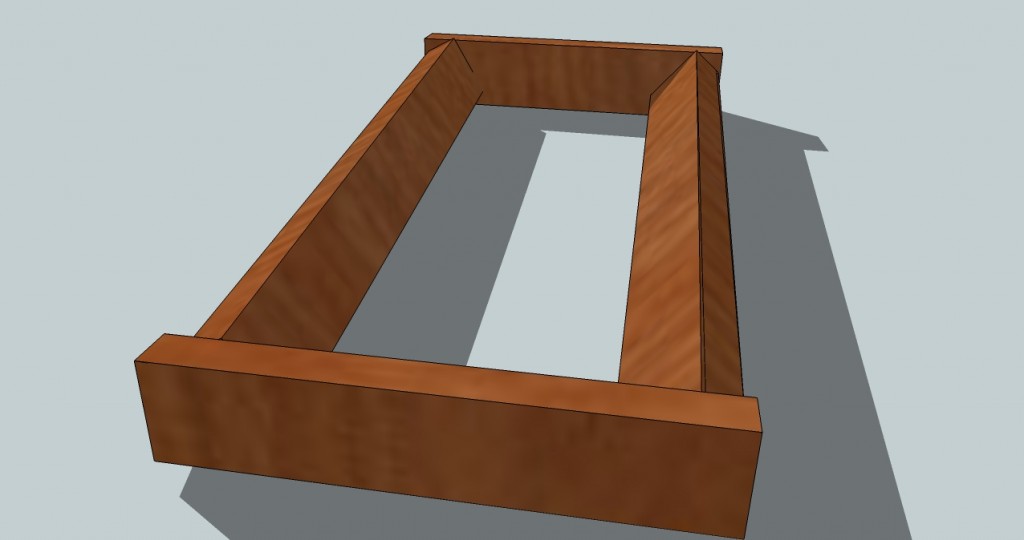
Step 1 of the original 2011 build: the barrel base. 03
Add the legs
Add a pair of 6" legs on one side and a pair of 12" legs on the other.
The different leg heights are what give the finished composter its intentional slope.
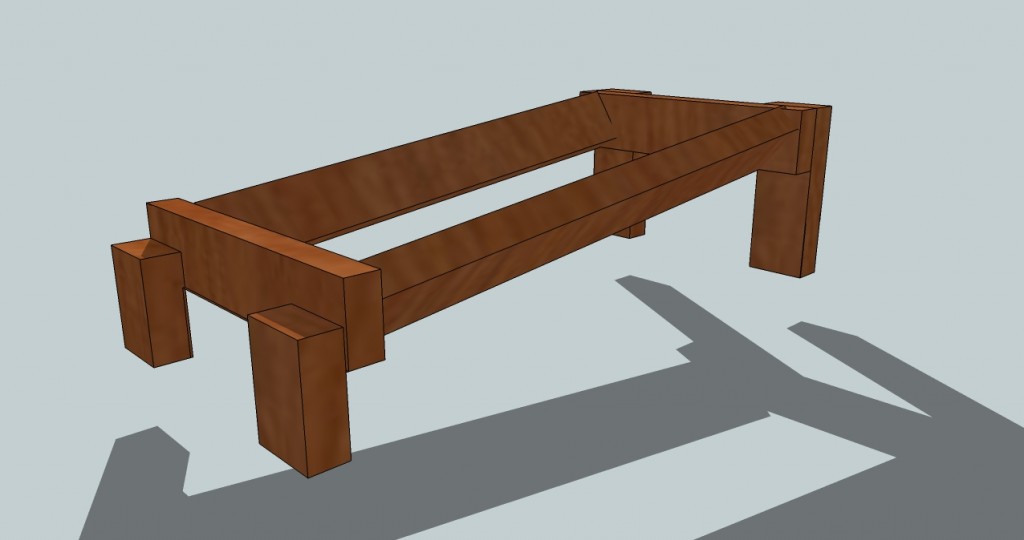
Unequal legs create the tilt of the barrel. 04
Brace the legs
Support the legs with a 19.5" piece in the front and a 19.5" piece in the back.
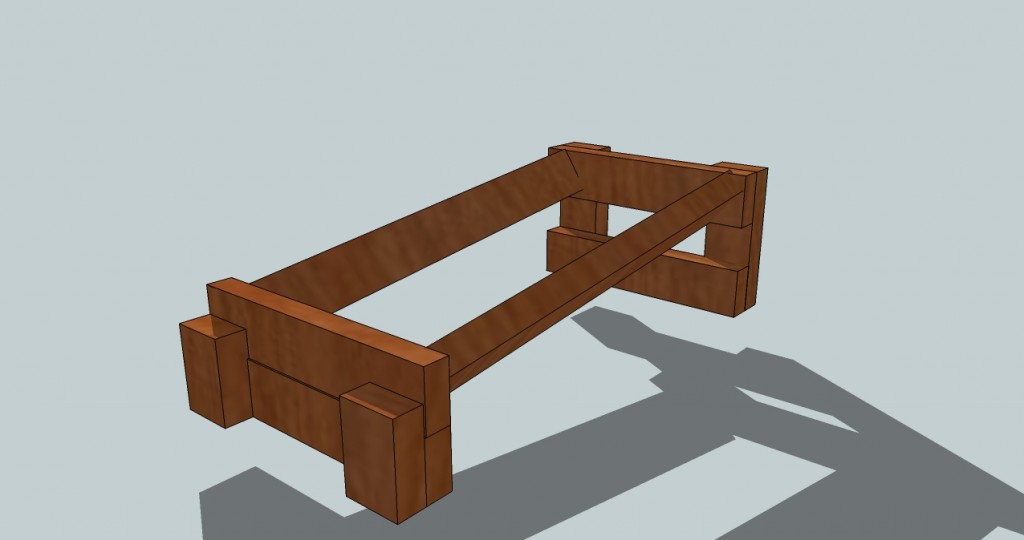
Front and back leg braces. 05
Connect the sides
Connect the two leg assemblies with two 42" pieces.
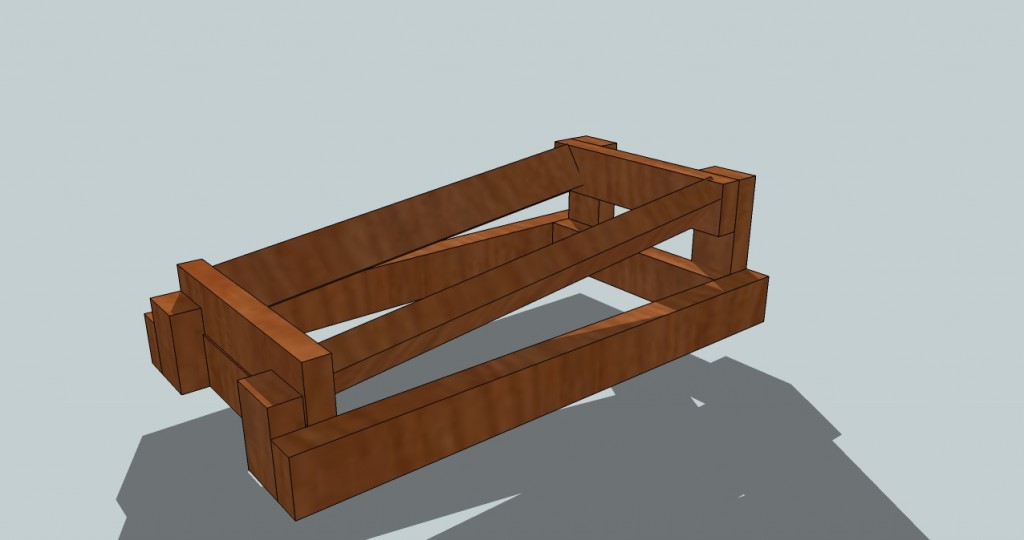
The two leg assemblies joined into one frame. 06
Add the caster wheels
Add the four 3" swivel caster wheels to make the base mobile.
Portability was one of the original design goals: the unit could be rolled between the chicken coop and the compost pile.
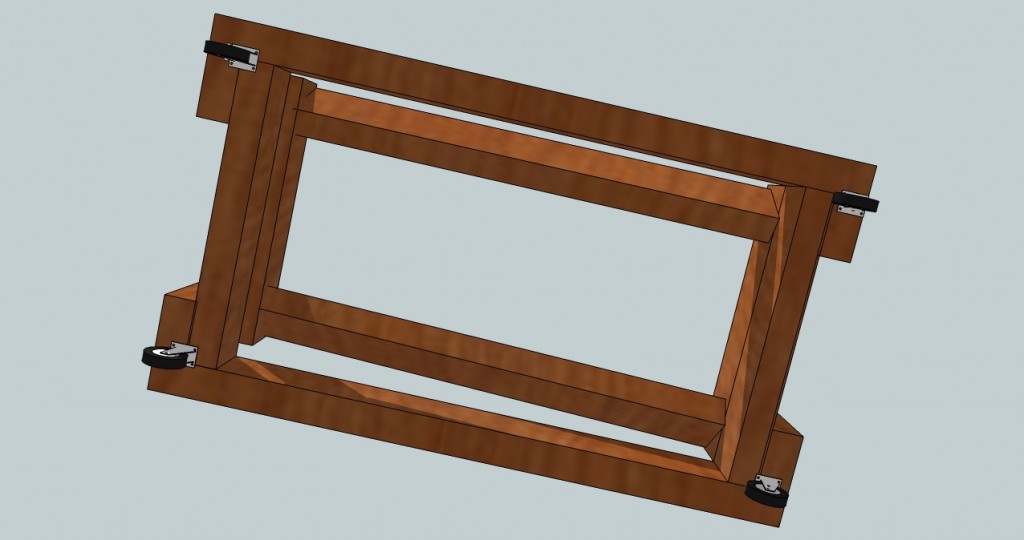
Casters make the composter mobile. 07
Add the front guard
Install the 4" piece of wood as the front guard.
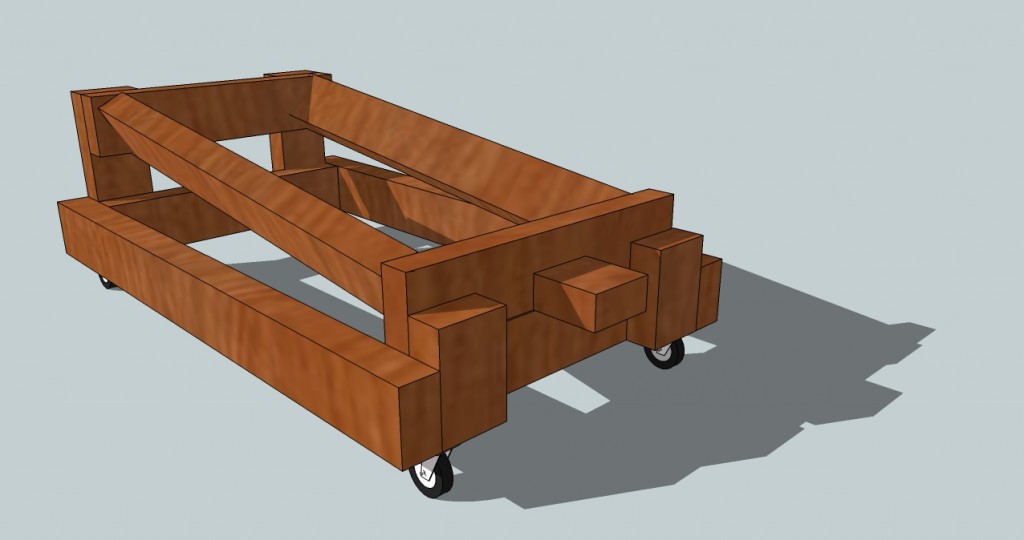
The front guard in place. 08
Install the PVC
Attach the 21" piece of 3/4" PVC to the base in the position shown.
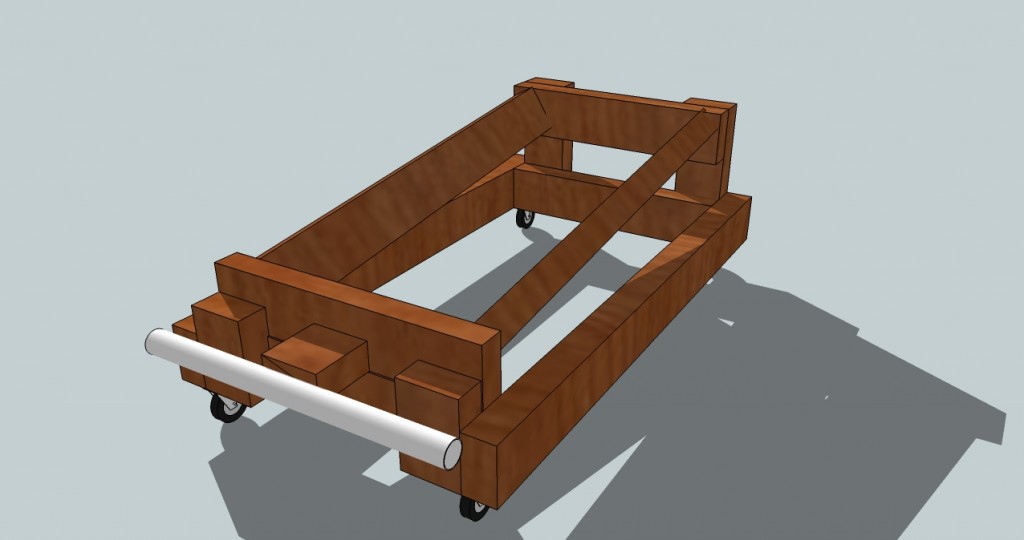
The PVC fitted to the base. 09
Install the lower rain gutter
Add the 21" rain gutter with its end caps to the top of the front of the base.
Do not secure it yet. Loose-fit the barrel first, all the way forward. Once you know where the barrel will rest, fasten the gutter in place.
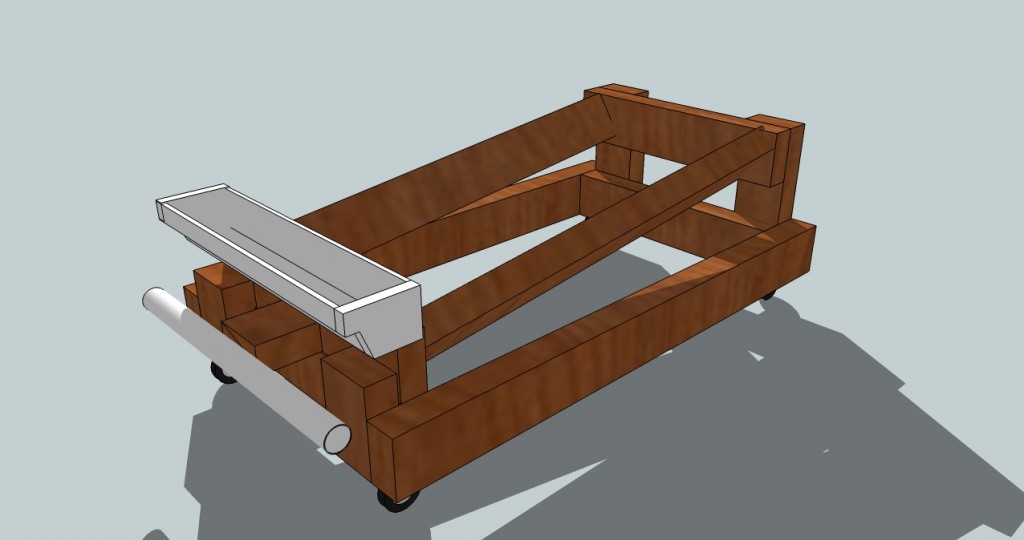
The feeding gutter at the front of the base. 10
Prepare the barrel
Drill a 1" hole into the food-grade 55-gallon barrel at the position shown.
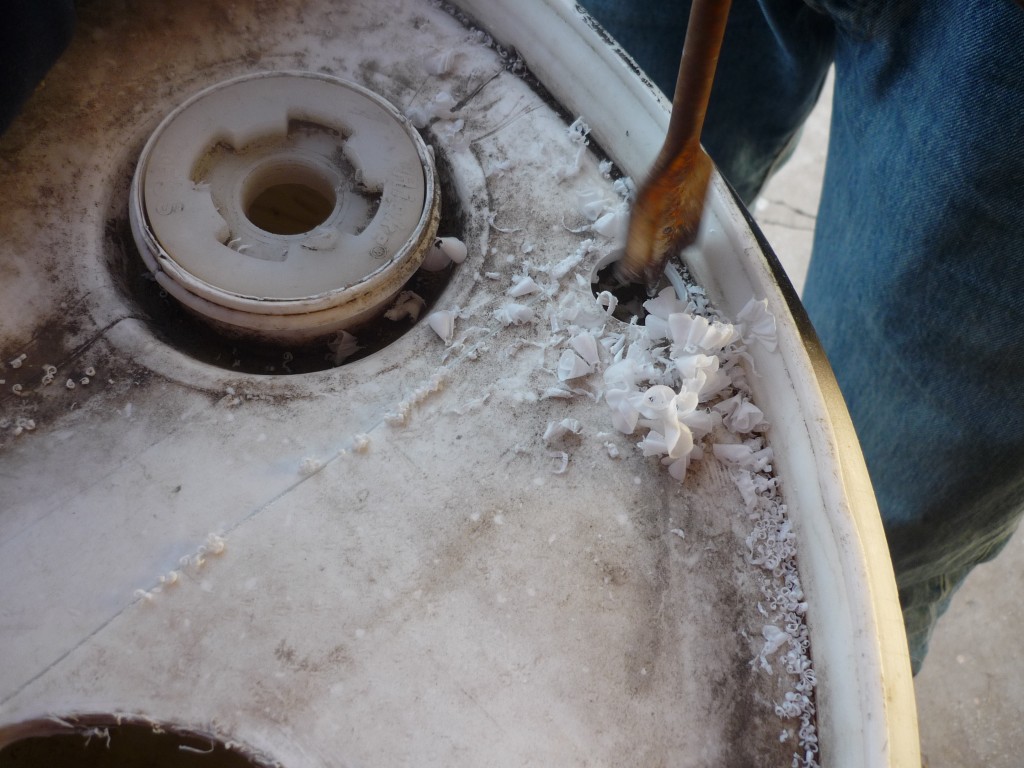
Original photograph P1090696 from the 2011 build. 11
Cut the barrel opening
Carefully cut out a "smile" in the barrel with the jig saw, as shown in the original photograph.
2026 Garden Pool note: start the cut from the drilled hole, support the barrel so it cannot shift, wear eye protection, and deburr the cut edge — jig-sawn plastic leaves sharp edges.
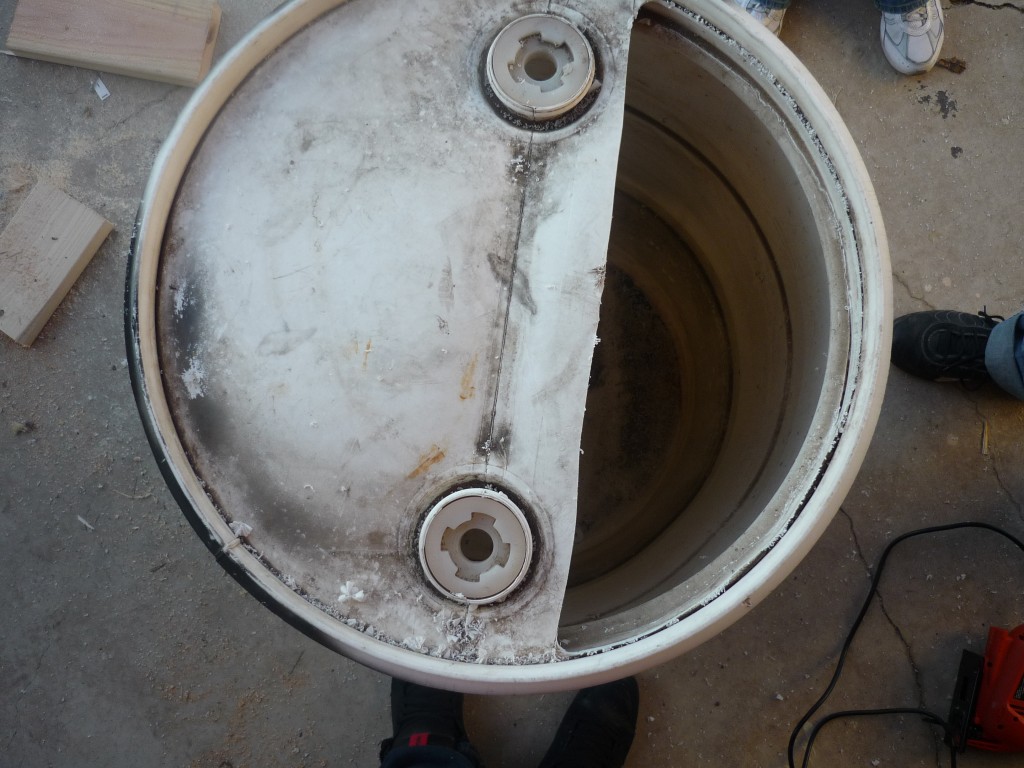
Original photograph P1090701 from the 2011 build. 12
Clean and position the barrel
Clean the barrel and place it on top of the completed base.
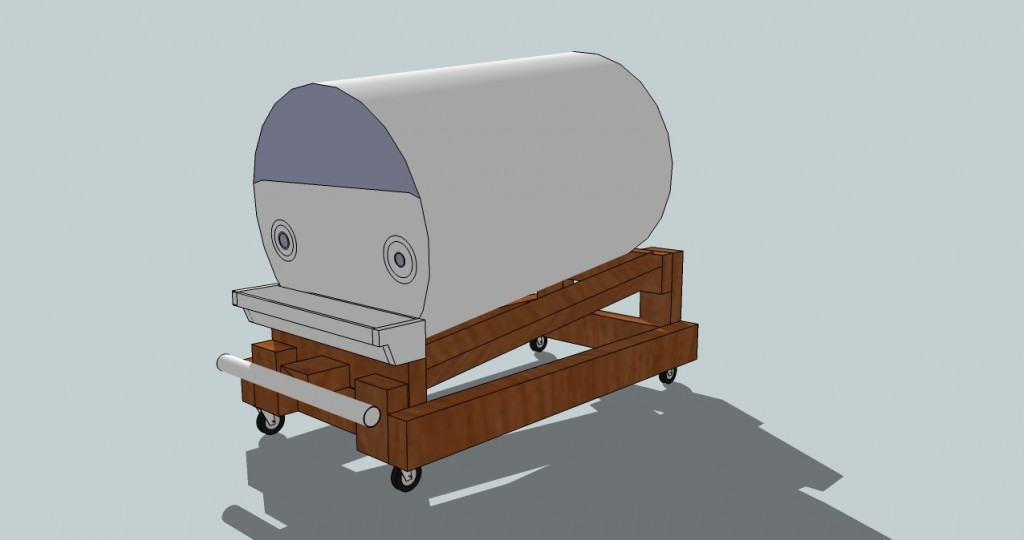
The barrel seated on the finished frame. 13
Install the internal ramp
Finally, add the 39" piece of rain gutter inside the barrel, all the way against the back.
The gutter should stick out just far enough that larvae crawling up it fall from the top gutter into the lower gutter.
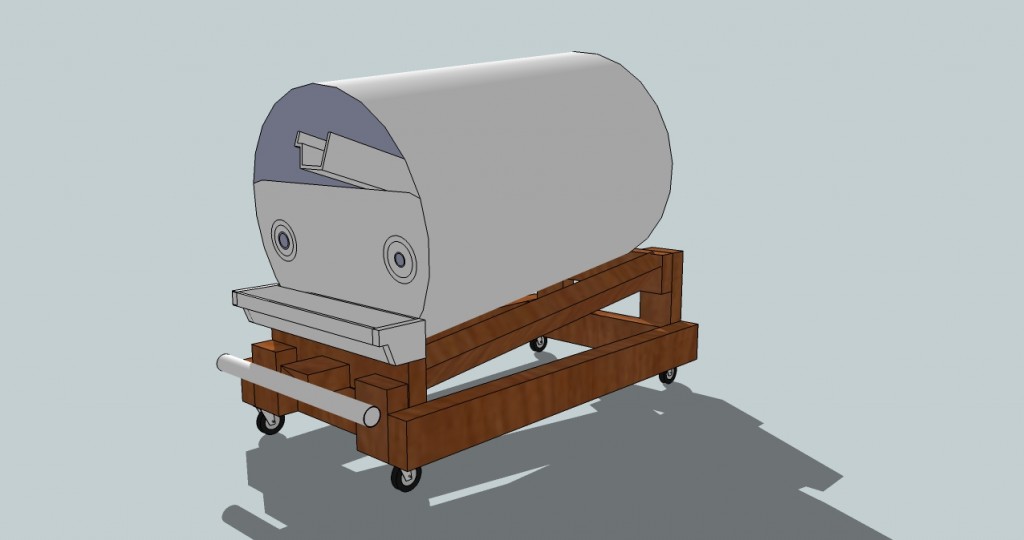
The finished design, with the internal migration ramp in place.
Results
The original Garden Pool system
The original Garden Pool flock included eight hens, and the completed feeder was designed so all eight could access it at the same time. That is a record of this specific build, not a stocking-rate recommendation.
Portability was the other goal that shaped the design: on its casters, the unit could be rolled between the chicken coop and the compost area as needed.
Background
What are black soldier flies?
The black soldier fly (Hermetia illucens) is a widespread non-pest fly. The adult does not bite and barely feeds; almost everything useful happens in the larval stage.
Larvae are voracious consumers of decomposing organic material, which is why they are used and studied in organic-waste conversion and as a feed ingredient. Toward the end of the larval stage they enter the prepupal stage and migrate away from the material they fed in — the behaviour this whole design depends on.
Garden Pool's interest is practical rather than academic: the larvae turn a waste stream into a resource, and they do it without needing to be sorted out by hand.
Systems thinking
A small example of a closed-loop food system
Food and garden scraps are usually treated as waste. Larvae turn some of that material into another biological resource. Chickens eat harvested larvae as a supplement. What remains continues through composting or soil-building.
That is the design philosophy that has run through Garden Pool since its earliest years: look for the relationships between systems rather than treating every input and output separately. The same thinking sits behind the Garden Pool aquaponics guide.
It is not "zero waste," and it does not replace purchased chicken feed. It is one loop closed a little tighter than it was before.
Classroom use
For teachers and educators
This project works as a hands-on case study across a surprising number of subjects, which is exactly why it was published as free class material in the first place.
- Biology
- Entomology
- Decomposition
- Nutrient cycling
- Food systems
- Animal agriculture
- Engineering
- Product design
- Waste reduction
- Circular systems
- Appropriate technology
- STEM
Garden Pool Classic • 2011
From the Garden Pool archives
Garden Pool originally published this project in 2011 as part of our effort to make sustainable food-production knowledge practical, affordable and accessible.
We are restoring our original educational resources — original author, original date, original photographs, original address — so growers, students, teachers, homesteaders and makers can keep learning from the systems we built and documented.
Questions
Black soldier fly composter FAQ
- What is a black soldier fly composter?
- It is a container system where black soldier fly larvae are used to break down food and garden scraps. Garden Pool's 2011 design used a 55-gallon food-grade barrel on a wheeled wooden frame, with a rain-gutter ramp that let mature larvae leave the barrel on their own.
- How does a self-harvesting black soldier fly system work?
- As larvae reach the prepupal stage they naturally crawl away from the feeding material to look for somewhere to pupate. A sloped ramp gives them an easy exit route, and they drop into a collection point instead of having to be sorted out by hand.
- Why do black soldier fly larvae crawl up the ramp?
- Not because of the ramp itself — it is their own migration behaviour at the end of the larval stage. The Garden Pool design simply puts a ramp where they are already trying to go.
- Can chickens eat black soldier fly larvae?
- Black soldier fly larvae are widely used and studied as a poultry feed ingredient, and Garden Pool's flock ate them from this feeder. Garden Pool does not give veterinary or animal-nutrition advice; follow your own animal-care guidance and any local rules on insect feed and food scraps.
- Does this system replace regular chicken feed?
- No. Garden Pool has always described larvae as a supplemental feed, not a complete diet or a replacement for a balanced ration.
- What size barrel did the original Garden Pool design use?
- A single 55-gallon food-grade barrel.
- Why is the barrel tilted?
- The original frame used 6" legs on one side and 12" legs on the other, which tilts the barrel and gives the internal gutter its slope so migrating larvae travel toward the exit.
- Why does the system use rain gutter?
- Rain gutter is cheap, common, easy to cut and already shaped like a channel — a ready-made migration ramp inside the barrel and a ready-made feeding trough outside it.
- What food scraps can go into a black soldier fly composter?
- The original Garden Pool unit was fed everyday food and garden scraps. What is appropriate depends on your climate, your management and your local rules — especially where the larvae will be fed to animals. Check the regulations that apply where you live.
- Does a black soldier fly composter smell?
- The original 2011 article reported little odour from the Garden Pool unit. In practice odour depends heavily on what you feed it, moisture, drainage, loading rate, temperature and general management.
- Can I use the leftover material as compost?
- The original article described emptying the barrel into the compost pile. Residue from a black soldier fly system is not necessarily the same as finished compost and may need further composting or curing depending on how you intend to use it.
- Can this project be used for education?
- Yes. It was published as part of Garden Pool's free class material and works well as a hands-on case study in decomposition, entomology, nutrient cycling, engineering and circular design.
Garden Pool Classic
More from the Garden Pool archives
Original Garden Pool projects, restored at their original addresses with their original authors, dates and photographs.
- Classic • 2011
Introduction to Shelfponics
Garden Pool's original bookshelf aquaponics system: an ordinary four-tier plastic shelf turned into a vertical growing system with a 10-gallon fish tank in about two square feet of floor space.
Read the restored project - Classic • 2013
How to Make a Simple 5-Gallon Bucket Aeroponics System
A compact low-pressure aeroponic growing and cloning system built from a food-grade 5-gallon bucket, a small pump and net pots.
Read the restored project
Keep exploring
Waste is just a resource in the wrong place
Garden Pool has been experimenting with ways to connect food, water, plants, animals and technology since 2009. This project is one example of what happens when we look at waste as a resource and design systems around natural processes.